The 2003 vs 2018 Problem: Why Door-Knocking After Hail Wastes Your Best Leads
Two homes on the same street, hit by the same hail, with completely different replacement odds. Here's why blanket canvassing leaves money on the table — and what scoring by roof age actually changes.
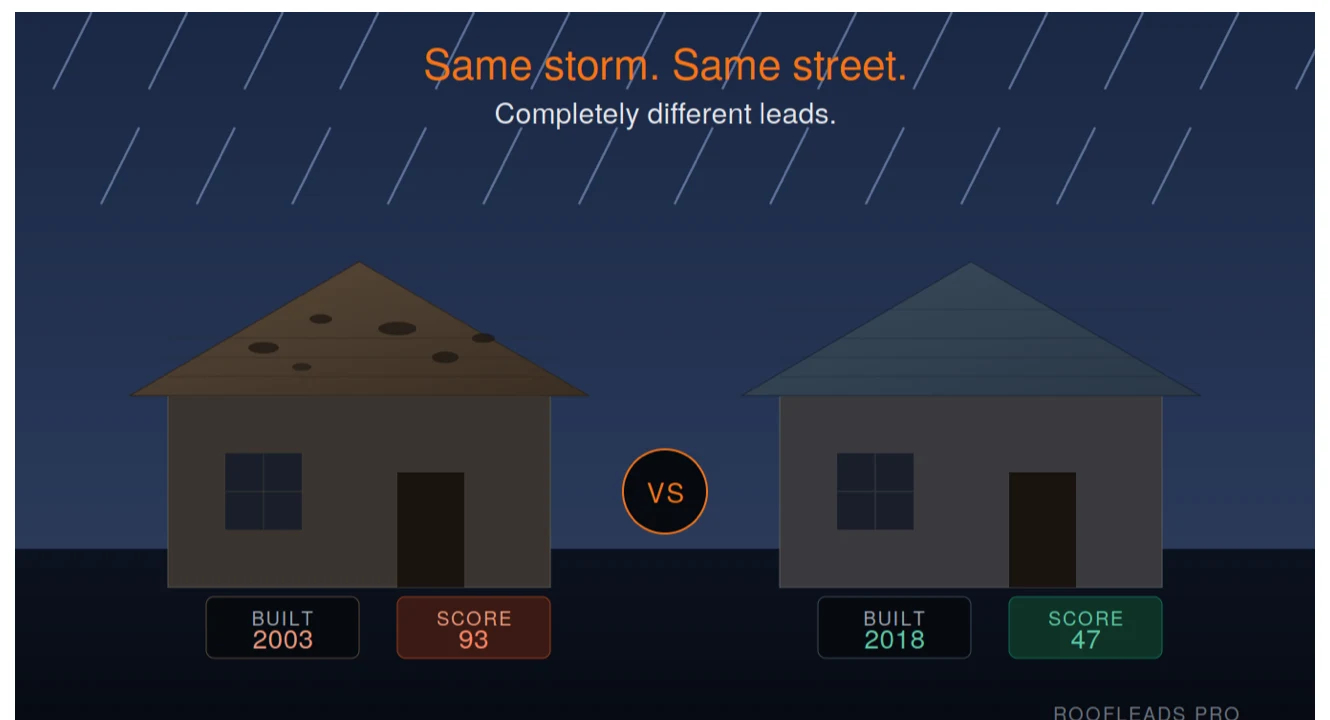
Picture a 2.5-inch hailstorm rolling through a north Denver suburb — a four-mile-wide swath, sixteen minutes of damage. By the next morning, every roofing truck in the area is rolling through the affected neighborhoods.
Here's what most of those roofers do: drive the storm zone, knock on doors, hand out cards, repeat. By the end of the week they've hit maybe 300 houses each. A handful turn into inspections. A few of those turn into jobs.
That's the standard playbook. It works, sort of. But it leaves most of the money on the table — and the reason has nothing to do with the roofer's skill or sales pitch.
The problem is that the storm zone treats every house equally. The 2018-built home with architectural shingles takes the same hail as the 2003-built home with three-tab composition next door. They look identical from the street. The roofer knocks on both doors the same way.
But statistically, those two houses are not equal. One is far more likely to need a full replacement — and far more likely to file an insurance claim — than the other.
That's the 2003 vs 2018 problem. And it's quietly the biggest inefficiency in storm-chasing roofing.
The math nobody talks about
Composition shingles have a useful life of roughly 15–25 years in Colorado's UV-intensive climate. After year 15, the asphalt binder starts breaking down. Granules loosen. Mat strength deteriorates. The shingle was never going to handle a serious hail event well, and now it's mid-decline.
Hail on a brand-new architectural shingle? The roof flexes, absorbs the impact, sheds the energy. Most strikes don't even leave a visible bruise — cosmetic damage at worst.
Hail on a 23-year-old three-tab? The granule layer fractures. The mat splits underneath. Within six months you've got leaks; by year two you've got rot in the decking. The insurance adjuster sees it as obvious storm damage and approves the claim.
Same storm. Same intensity. Different roof, completely different outcome.
This isn't theory. Insurers' own loss data has long pointed the same direction: roofs well past 15 years old file hail claims at several times the rate of newer roofs, and a far higher share of those claims are approved for full replacement rather than repair. If you're knocking 300 doors after a storm and not factoring in roof age, you're treating a five-figure replacement opportunity and a not-worth-claiming cosmetic bruise exactly the same way. The math punishes you for not discriminating.
What scoring actually means
A scored lead is just a way of telling you, before you drive there, which of those 300 affected homes is actually likely to convert. The math isn't complicated — four signals do most of the work:
Roof age. The single biggest predictor. A roof at year 18 has a fundamentally different damage profile than one at year 8. Year built from county assessor data gives you a baseline; building-permit records (where available) refine it. A house built in 2003 with no roof permit since is almost certainly on its original shingles — a 22-year-old roof.
Storm severity. Not just "did the storm hit" but "how hard." A 1.5-inch hail event is meaningfully different from a 2.5-inch event, and wind speed compounds it. NOAA's Storm Events Database publishes this with surprising precision.
Roof material. Three-tab composition is the most vulnerable. Architectural composition is moderately resistant. Tile and metal are largely hail-resistant. Wood shake is in between.
Property value. Not a damage signal — a commercial-viability signal. A higher-value home is more likely to file a claim and pay a deductible. A low-value rental might not.
Combine those four and you get a 0–100 score per address. The 90+ scores are the homes worth driving to first. The sub-60 scores are the homes you skip until you've hit everyone else.
Why the map is just the beginning
Most Colorado roofers using a hail-tracking tool get a storm map. The map shows you where the storm hit. That's it.
That's useful — you know where to drive. But the map can't tell you that the 1995-built house with no roof permits since needs a roof and the 2019-built house next door probably doesn't. You still have to figure that out at the door, after you've already driven there.
This is the door-knocking trap. You spend eight hours driving the storm zone, knock 30 doors, get 3 inspections, close 1 job. You'd convert at a much higher rate if you'd skipped the houses that were never going to be a fit. The leverage isn't in driving more streets — it's in driving the right streets first.
What this looks like in practice
Here's how the math plays out on a representative 2.5-inch metro storm:
- A few hundred properties land inside the core hail swath
- Roughly a third of them score 80+ — your high-priority leads
- A meaningful slice have roofs 18+ years old on composition shingles
- The strike zone skews toward higher home values, which lifts claim dollars
A roofer who works the high-priority leads first books the same inspections as one working the full list at random — but in half the time, and at half the windshield-and-gas cost. Same outcome, double the cost. That's the inefficiency.
Where this goes
The roofing industry is following the same arc as every other lead-generation industry. Twenty years ago, real estate agents drove neighborhoods looking for "for sale by owner" signs; now they use property data and propensity scoring. Twenty years ago, B2B salespeople called every company in the Yellow Pages; now they use intent data and scoring models.
Roofing is just a few years behind. The roofers who figure out the scoring math first will get the high-conversion leads before everyone else realizes the door-knocking blanket strategy is leaving money on the table.
The map alone is not enough anymore. The math is what matters.
One roofer per city. Real leads from real storms.
Exclusive Colorado territories with NOAA-verified storm scoring and TCPA-compliant outreach data.
Radar found 99% of Colorado's 2026 spotter-confirmed hail. But the size number on the map is a different animal — and the 'biggest stone near this house' figure most maps show you runs about 1.25 inches high. Here's how to read one like a roofer.
Straight-line wind gets skipped because there's no hailstone to hold up on a doorstep. But an 80 mph downburst tears more shingles off a street than a marginal 1-inch hail core does — and almost nobody is working those addresses.
North Texas quietly moved from 1% to 2% wind/hail deductibles, and carriers are settling older roofs at ACV. That combination kills a whole class of 2026 hail claims before you ever write an estimate — and it changes which addresses deserve your crew's morning.