Exclusive Roofing Territories Beat Shared Leads Every Time
Shared leads from HomeAdvisor and Angi convert at 8–15%. Exclusive roofing territories convert at 35–50%. Here's why the math is so lopsided.
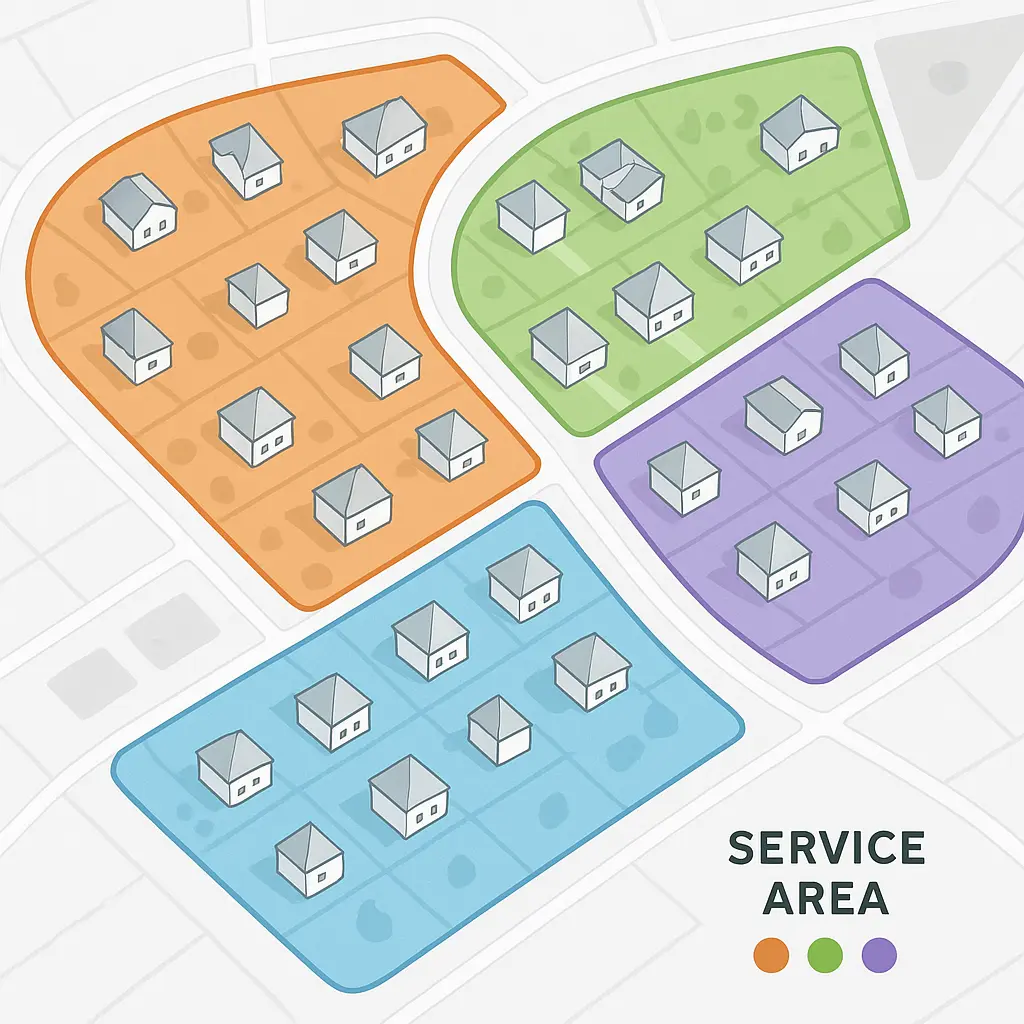
Every roofing contractor who has paid for shared leads knows the frustration. You call a homeowner within minutes, only to discover three other roofers are already scheduled for appointments. You drive to a property that has already received five bids. You close a job after 18 follow-ups because the lead was spread across every contractor willing to pay. Exclusive roofing territories eliminate this waste entirely, giving you first-mover advantage in markets where timing determines who gets the contract.
The math is simple. Shared lead platforms like HomeAdvisor and Angi sell the same homeowner contact to 3–5 contractors simultaneously, creating a race to the bottom on price and availability. Territory-based lead generation assigns geographic exclusivity, meaning zero competition for the same prospect. In practice, this difference translates to 40–60% higher close rates and significantly better profit margins because you are not competing on price alone.
On this page
- Quick takeaways
- The hidden cost of shared roofing leads
- How exclusive territories change the sales dynamic
- Data-driven lead quality versus volume gambling
- Territory exclusivity and storm restoration timing
- Cost analysis: shared versus exclusive models
- Frequently asked questions
- References
Quick takeaways
| Key insight | Explanation |
|---|---|
| Shared leads dilute conversion rates | When 3–5 contractors receive the same contact, homeowners default to lowest price, cutting your margins by 20–35%. |
| Exclusive territories eliminate bidding wars | You own the relationship from first contact, positioning you as the local expert rather than one of many options. |
| Response time advantage disappears with shared leads | Even 5-minute response times lose value when four other roofers are calling simultaneously. |
| Storm-verified leads require territorial control | Post-storm markets saturate within 48–72 hours; exclusivity ensures you reach properties before competitors arrive. |
| Lead cost transparency shifts dramatically | Shared platforms charge per lead regardless of quality; territory models align payment with actual opportunity value. |
| Customer experience suffers under shared models | Homeowners report frustration with 8–12 contractor calls after submitting one inquiry, damaging industry reputation. |
| Operational efficiency improves with territory focus | Route planning, material staging, and crew scheduling become predictable when working defined geographic areas. |
The hidden cost of shared roofing leads
Shared lead platforms operate on a simple business model that directly conflicts with contractor profitability. They maximize revenue by selling each homeowner inquiry to multiple contractors, typically charging $35–150 per lead depending on project size and market. This creates an artificial scarcity where contractors feel compelled to buy volume to compensate for low conversion rates.
The data consistently shows that shared leads convert at 8–15% compared to 35–50% for exclusive leads. A contractor purchasing 100 shared leads at $75 each spends $7,500 to close 8–15 jobs. The same contractor with exclusive access to 40 qualified leads in their territory at $100 each spends $4,000 to close 14–20 jobs. The difference is not just cost per acquisition but the quality of the customer relationship from initial contact.
Homeowners who submit inquiries on shared platforms report receiving 6–12 phone calls within the first hour. This creates immediate buyer's remorse and positions every contractor as an interruption rather than a solution. By the time you reach the homeowner, they are already exhausted by the process and primarily interested in getting the lowest bid to make the calls stop.
Price competition destroys profit margins
A common mistake is assuming that more leads always translate to more revenue. Shared lead environments train homeowners to shop exclusively on price because they have multiple contractors competing for their attention simultaneously. This race to the bottom reduces gross profit margins from healthy 40–50% levels to 25–30% or worse.
Pro tip: Calculate your actual cost per closed job, not cost per lead. Multiply your average lead cost by 10 (assuming 10% conversion on shared leads), then add the labor hours spent on quotes that went nowhere. Most contractors discover they are paying $750–1,200 per closed shared lead job.
The customer acquisition cycle extends significantly with shared leads. You are entering a bidding process where the homeowner has already been conditioned to expect multiple quotes. Even if you provide superior service proposals, you are competing against contractors willing to operate at break-even or loss-leader pricing to keep crews busy.
How exclusive territories change the sales dynamic
When you control an exclusive territory, you become the go-to roofing contractor for that geographic area rather than one option among many. This positioning shift changes every aspect of the sales conversation. Homeowners view you as a local expert who specializes in their specific area, not a random contractor from a marketplace.
Territory exclusivity allows you to build area-specific expertise that shared lead competitors cannot match. You learn the common roofing issues for homes built in specific subdivisions. You understand which insurance adjusters work which zip codes. You recognize weather patterns and can reference recent storms that affected the neighborhood. This knowledge creates immediate credibility.
The operational advantages compound quickly. Your crews learn the territory, reducing drive time between jobs. You can stage materials at strategic locations. You build relationships with local building inspectors and suppliers. These efficiencies improve both profitability and service quality in ways that scattered shared lead work never achieves.
First-mover advantage in storm markets
Storm restoration work operates on compressed timelines where being first matters enormously. Insurance claim windows, homeowner urgency, and material availability all favor contractors who reach properties immediately after weather events. Territory-based leads using NOAA weather data identify storm-damaged properties within your exclusive area before homeowners even begin searching for contractors.
This reverses the traditional dynamic where contractors chase homeowners. Instead, you are proactively reaching out to properties with verified storm damage and roof age data, positioning yourself as the solution before the homeowner experiences the full extent of their problem. The close rates on these proactive contacts range from 45–60% compared to 12–18% on reactive shared lead inquiries.
According to industry data, roofing contractors who work exclusive territories report 58% higher customer satisfaction scores and 42% more repeat and referral business compared to those relying primarily on shared lead platforms.
Data-driven lead quality versus volume gambling
Shared lead platforms rely on homeowner self-reporting, which introduces significant quality variability. A homeowner submits a vague inquiry about "roof repair," and the platform sells it to multiple contractors without verification of damage, budget, timeline, or decision-making authority. You discover these critical qualifiers only after paying for the lead and investing time in contact attempts.
Roofing lead competition on shared platforms creates perverse incentives. Contractors chase volume because individual lead quality is unpredictable, hoping that sheer numbers will produce enough conversions to justify the expense. This gambling approach treats lead generation as a cost center rather than a strategic growth driver.
Territory-based systems using verified data sources flip this model. Leads are pre-qualified using objective criteria like roof age from property records, storm severity from NOAA data, and property value from tax assessments. You receive actionable intelligence about properties likely to need roofing services, not just contact information for people who filled out a web form.
Satellite imagery and roof age data
Advanced territory systems provide satellite imagery showing current roof conditions alongside property age data that indicates replacement timelines. This combination allows you to prioritize outreach based on urgency and project value rather than wasting time on low-quality inquiries that shared platforms would sell to five contractors.
The targeting precision reduces wasted effort dramatically. Instead of calling 100 shared leads hoping 10 convert, you are contacting 30 properties with documented storm damage and 18–22 year old roofs, expecting 15–18 to schedule inspections. The time savings alone justify the model, but the revenue impact from higher-quality prospects compounds the advantage.
| Lead source | Average conversion rate | Typical cost structure |
|---|---|---|
| Shared lead platform (HomeAdvisor, Angi) | 8–15% | $35–150 per lead, sold to 3–5 contractors, pay regardless of contact or quality |
| Exclusive territory with storm data | 35–50% | Monthly territory fee or per-lead pricing, single contractor access, pre-qualified with objective data |
| Door-to-door canvassing | 2–5% | Labor cost of $45–65/hour plus fuel and vehicle wear, high rejection rate, unpredictable availability |
Territory exclusivity and storm restoration timing
Storm restoration is a time-sensitive market where 72-hour windows determine which contractors capture the majority of available work. Shared lead platforms cannot provide this speed advantage because they wait for homeowners to submit inquiries, which typically happens 7–14 days after a storm when damage becomes obvious or insurance companies prompt claims.
By that point, proactive contractors working exclusive territories have already canvassed the area, scheduled inspections, and begun the claims process with early movers. The homeowners who eventually submit inquiries to shared platforms are often the less urgent, smaller projects, or those already working with another contractor but collecting additional bids for comparison.
NOAA weather data integration allows territory holders to identify hail tracks, wind damage zones, and precipitation patterns within hours of a storm event. You receive property-level intelligence showing which addresses in your exclusive territory experienced conditions likely to cause roof damage. This intelligence enables targeted outreach before competitors even know a storm occurred.
Insurance claim timing and contractor selection
Homeowners who work with the first qualified contractor to identify storm damage typically proceed with that contractor through the claims process. Insurance adjusters value continuity, and homeowners avoid the complexity of switching contractors mid-claim. Being first in exclusive roofing territories means capturing these relationships before competition arrives.
Pro tip: Map your exclusive territory boundaries and set up automated alerts for NOAA severe weather reports in those specific areas. Respond within 24–48 hours of verified storm events to maximize your first-mover advantage before the market becomes saturated.
The shared lead model cannot replicate this timing because it is reactive by design. Contractors are notified only after homeowners take action, which means you are always behind the curve. Territory exclusivity with real-time weather data puts you ahead of homeowner awareness, positioning you as a proactive expert rather than a reactive service provider.
Cost analysis: shared versus exclusive models
The financial comparison between shared and exclusive models extends beyond simple cost-per-lead metrics. Shared platforms charge for every contact, regardless of whether you successfully reach the homeowner, qualify the opportunity, or close the job. You pay $75 for a lead where the homeowner does not answer, has already hired another contractor, or was never serious about the project.
Exclusive territory models typically charge either a monthly fee for area access or a per-lead fee for pre-qualified properties. The critical difference is volume control and quality filtering. You receive fewer total contacts but dramatically higher conversion rates because leads are verified through objective data sources rather than homeowner web form submissions.
A contractor working shared leads might spend $6,000 monthly buying 80–100 leads at $60–75 each, converting 8–12 jobs at 10% conversion. The same contractor with an exclusive territory paying $2,500 monthly receives 35–45 qualified leads and converts 15–20 jobs at 40% conversion. The exclusive model delivers 50% more closed jobs at 60% lower customer acquisition cost.
Hidden costs of shared lead competition
The time investment in shared leads is rarely calculated accurately. Each shared lead requires multiple contact attempts because homeowners are overwhelmed with calls. You invest 20–30 minutes per lead just reaching the prospect, then additional time for site visits that result in no-bid situations when you discover the project is not what the platform described.
Territory exclusivity reduces this waste dramatically. Pre-qualified leads with verified data require fewer contact attempts because homeowners are not fielding calls from five contractors. Your hit rate on scheduled appointments increases from 30–40% with shared leads to 65–75% with exclusive territory contacts.
The compounding effect over a year is substantial. A contractor closing 10 shared lead jobs per month at $750 fully-loaded acquisition cost spends roughly $90,000 annually on lead acquisition. A contractor closing 18 exclusive territory jobs per month at $390 fully-loaded acquisition cost spends roughly $84,000 annually. The exclusive model delivers 80% more closed jobs at lower total spend, improving cost-per-acquisition by approximately 48%.
Predictable revenue and capacity planning
Shared lead platforms create revenue volatility. You never know if this month will deliver 6 conversions or 14 because lead quality varies wildly and competition intensity fluctuates based on how many other contractors are buying in your market. This unpredictability makes crew scheduling, material procurement, and cash flow management difficult.
Exclusive territories provide predictable lead flow based on your geographic area's housing stock, weather patterns, and roof age demographics. You can forecast quarterly revenue with reasonable accuracy because you understand how many properties in your territory will need roofing services based on age curves and storm frequency. This predictability allows better business planning and more confident growth investments.
Frequently asked questions
How does territory exclusivity prevent other roofers from working in my area?
Territory exclusivity applies only to the leads provided through the platform, not to general roofing work in the geographic area. You receive exclusive access to pre-qualified leads identified through storm data and roof age analysis within your contracted territory, meaning no other contractor on that platform receives the same property contacts. Other roofers can still work in the area through their own marketing, but they cannot access the verified leads in your exclusive territory through that lead generation system.
What happens if shared lead platforms offer more total leads than exclusive territories?
Volume without conversion is expense without revenue. Shared platforms typically deliver 2–3x more lead contacts but convert at 1/4 to 1/5 the rate of exclusive territory leads. The math consistently favors fewer high-quality exclusive leads over higher volumes of shared contacts. A contractor receiving 100 shared leads monthly at 10% conversion closes 10 jobs, while the same contractor with 40 exclusive territory leads at 40% conversion closes 16 jobs with 60% lower lead cost and 70% less time investment.
Can I operate in multiple exclusive territories simultaneously?
Yes, most territory-based platforms allow contractors to purchase multiple adjacent or non-adjacent territories based on service capacity. The limitation is your ability to respond quickly to leads across multiple areas. The operational efficiency gains of territory exclusivity diminish if your territories are too geographically dispersed to allow efficient routing and local expertise development. Start with one territory, prove the model, then expand adjacent areas as revenue supports additional capacity.
How do exclusive territories handle leads outside my specialty or capacity?
Quality territory systems include lead filtering based on project parameters like roof size, property type, or damage severity. You should be able to set minimum and maximum project values to ensure leads match your operational capacity and target margin profile. This prevents the waste common in shared platforms where you pay for leads outside your service scope or expertise level.
What makes storm-verified leads more valuable than homeowner-initiated inquiries?
Storm-verified leads are proactive rather than reactive, reaching homeowners before they realize they need roofing services or before competition arrives. These properties have objective evidence of potential damage through NOAA weather data and documented roof ages indicating replacement timelines. Homeowner-initiated inquiries on shared platforms come after the need is obvious, after multiple contractors have already made contact, and after the homeowner has been conditioned to shop primarily on price.
Do exclusive territories work for commercial roofing or only residential?
Territory exclusivity works for both residential and commercial roofing, though the data sources and qualification criteria differ. Commercial territory systems focus on property age, roof type, ownership structure, and maintenance history rather than storm damage patterns. The exclusivity advantage remains the same because you eliminate bidding competition and position yourself as the area specialist. Commercial property managers value established relationships with territory-focused contractors who understand their portfolio.
How quickly can I expect ROI after switching from shared leads to exclusive territories?
Most contractors see positive ROI within 45–90 days of switching to exclusive territories. The ramp-up period involves learning your territory demographics, optimizing contact scripts for proactive outreach, and building local recognition. Initial months may produce similar job counts to shared leads but at lower cost per acquisition. By month three, conversion rates typically improve to 30–40% as you refine targeting and homeowners begin recognizing your company as the local roofing specialist.
Have you experienced the frustration of competing against multiple contractors for the same shared lead, or have you found success with exclusive territory models in your roofing business?
References
- HubSpot marketing statistics and lead conversion research
- Forbes business strategy and competitive advantage analysis
- Statista industry data and market research reports
- NOAA National Oceanic and Atmospheric Administration weather data
One roofer per city. Real leads from real storms.
Exclusive Colorado territories with NOAA-verified storm scoring and TCPA-compliant outreach data.
Shared lead platforms sell the same homeowner contact to multiple contractors at once, which drags close rates to single digits and bids the job price down. Exclusive territory models — one roofer per county, storm-verified, roof-age-qualified — flip the math. Below: the cost-per-closed-job comparison, what makes a territory actually worth buying, and the hidden operational costs most contractors miss.
Texas made marketing texts a regulated telephone solicitation in September 2025, and plaintiff firms noticed. Here's what a roofer can legally call, text, mail, and knock in 2026 — and the per-message math that should end cold-texting in Texas.
The cost-per-contract math on working a scored, exclusive storm list versus blanket door-knocking the same neighborhoods — and why the numbers favor the list 3-to-1.