Colorado Will Help Pay for Hail-Resistant Roofs — What SB26-155 Means for Roofers
Colorado's new hail-resilience law took effect August 12, 2026: up to ~$100M in state funding for hail-resistant roofing grants starting 2027, plus enforced insurance discounts for Class 4 roofs. Here's the playbook for roofing contractors.

Quietly, while everyone watched the radar, Colorado passed the most contractor-relevant piece of legislation in years. Senate Bill 26-155 took effect on August 12, 2026 — and starting in 2027, the state will help homeowners pay for hail-resistant roofs.
If you sell roofs anywhere on the Front Range, this law is about to change your sales conversation. Here's what it actually says, why it exists, and what a smart contractor does about it in the next six months.
What SB26-155 actually does
Signed in June 2026, the law creates the Strengthen Colorado Homes Enterprise — a state program funded at up to roughly $100 million over five years — with two jobs:
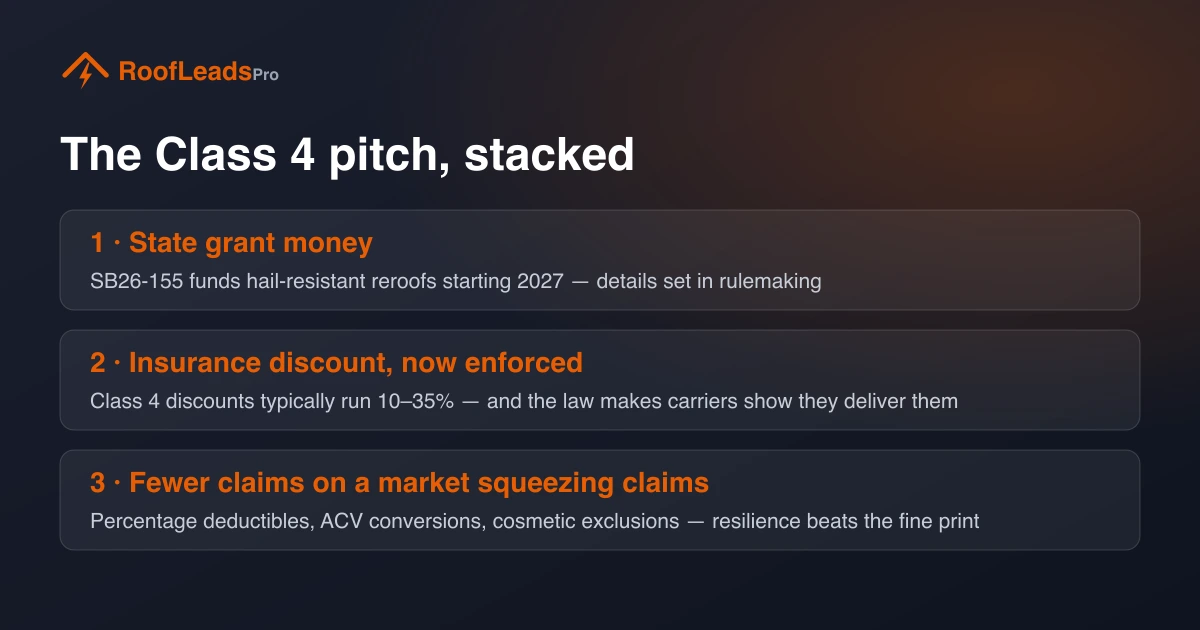
- Grants for hail-resistant roofing. Starting in 2027, the enterprise is expected to begin issuing grants that help Colorado homeowners upgrade to impact-resistant (Class 4) roofing. The exact eligibility rules, dollar amounts, and application process are being set in rulemaking now — nobody, including us, can tell you the per-home number yet.
- Insurance discounts with teeth. Colorado already nudged carriers to discount premiums for impact-resistant roofs. SB26-155 goes further: insurers must demonstrate that resilient-roof discounts actually reach policyholders. The 10–35% Class 4 discounts that used to live in the fine print now have enforcement behind them.
One honest caveat, twice for emphasis: the grant program details are not final. Treat every number about 2027 as "expected, pending rulemaking" — and be the contractor who says exactly that to homeowners, because the ones promising specific grant checks today are going to eat those promises later.
Why Colorado did this
Because the homeowners you sell to are getting crushed.
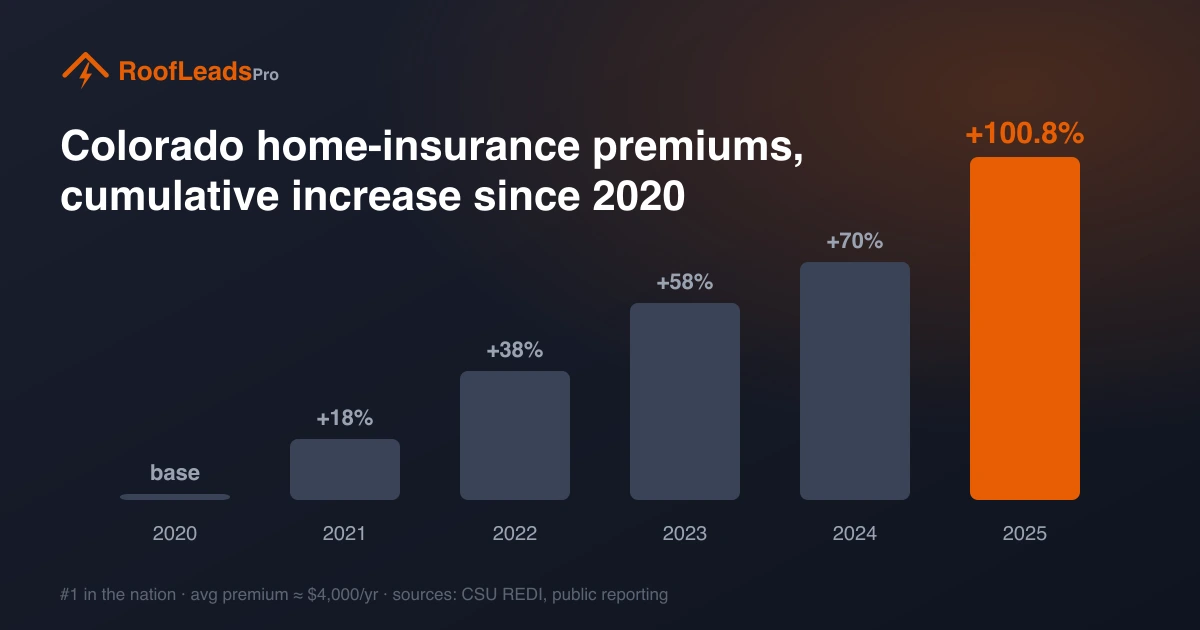
Colorado now leads the nation in home-insurance cost increases — premiums are up more than 100% cumulatively since 2020, including +18.3% in 2025 alone, with the average policy running around $4,000 a year. Behind the price increases sits a harsher structural shift you've already met at the kitchen table:
- Percentage deductibles. Wind/hail deductibles of 1–2% of dwelling value are now standard — a $6,000–$12,000 out-of-pocket on a typical Front Range home.
- The quiet RCV→ACV migration. More policies pay depreciated value on older roofs instead of replacement cost.
- Cosmetic-damage exclusions spreading through renewals.
- Non-renewals driven by aerial imagery — carriers dropping homes with aging roofs before a claim is ever filed.
The state's answer is resilience: fewer destroyed roofs, fewer claims, slower premium spiral. Your answer should be to sell what the state is now subsidizing.
The new sales conversation
For twenty years the Colorado storm pitch has been: hail hit your roof, insurance owes you a new one. That pitch still works — but it's getting squeezed from every direction listed above.
SB26-155 hands you a second pitch that works on homes with no claim at all:
"Your roof is 22 years old. Your carrier is one hailstorm away from non-renewing you — and your deductible is five figures anyway. Starting next year, the state of Colorado is expected to help pay for an impact-resistant roof, and your insurer is now required to show you the discount for it. Want to be at the front of that line or the back?"
That's not a storm-chase. That's a resilience upgrade — and it stacks three ways: expected grant money, an enforced premium discount worth hundreds per year, and an end to the annual hail-damage lottery for that homeowner.
The playbook for the next six months
1. Get fluent in Class 4 before your competitors do. Know the impact-resistant shingle lines your distributors carry, the cost delta over standard architectural shingles, and the manufacturer certifications involved. When the grant rules drop, the contractors already quoting Class 4 win the first wave.
2. Build your waitlist now. The homeowners who benefit most from a 2027 grant are identifiable today: roofs 15+ years old, in verified hail zones, still on their original shingles. Every one of them you talk to this fall is a spring 2027 job. "The program opens next year — I'll put you on my list and call you the week the rules publish" is a close, not a punt.
3. Watch the rulemaking. The enterprise's program rules will define eligibility, funding per home, and whether contractors interact with the program directly. We'll cover the details here when they land.
4. Don't oversell it. No specific dollar promises, no "the state will pay for your roof." The contractors who play this straight will own the category when the money is real; the ones who don't will spend 2027 doing damage control.
5. Keep working the claim window. None of this replaces storm work — Colorado's 12-month claim window still governs every verified hail event, and this June's Front Range storms are ticking toward their deadlines right now.
Where the data comes in
The grant-fit homeowner — old roof, verified hail exposure, no recent re-roof — is exactly what parcel records plus storm history can find at scale. It's the same intelligence that powers our Insurance Timeout list: homes aging toward carrier ACV cutoffs, ranked by replacement likelihood, before any storm hits.
If you hold a RoofLeads territory, you already have this list — filter for 15+ year roofs and start the waitlist conversation this fall. If your city is still open, check the map — one roofer per city gets it.
This article is general information, not legal or insurance advice. SB26-155's grant program details are subject to rulemaking; verify current program rules before making representations to homeowners.
One roofer per city. Real leads from real storms.
Exclusive Colorado territories with NOAA-verified storm scoring and TCPA-compliant outreach data.
Neither state licenses roofers, so every rule that matters is local. Here's what Denver, Colorado Springs, Dallas and Fort Worth actually require, what each one costs you in time, and why the license line is the cheapest competitive moat a local roofer has after a hail storm.
A ZIP code's hail history is the fastest free check a roofer can run before buying a list, opening an office, or sending a crew. It's also easy to misread. Here's what the count, the dates, the sizes and the ground reports each tell you, with real Colorado and Texas ZIPs.
More Colorado and Texas policies now carry a cosmetic damage exclusion for roof coverings. Here's how the endorsement works, which roofs it actually bites on, what it does to your storm list, and how to talk about it at the door without playing adjuster.